The Six-Ingredient Breakdown
What each compound does, how it works, and why we chose it.
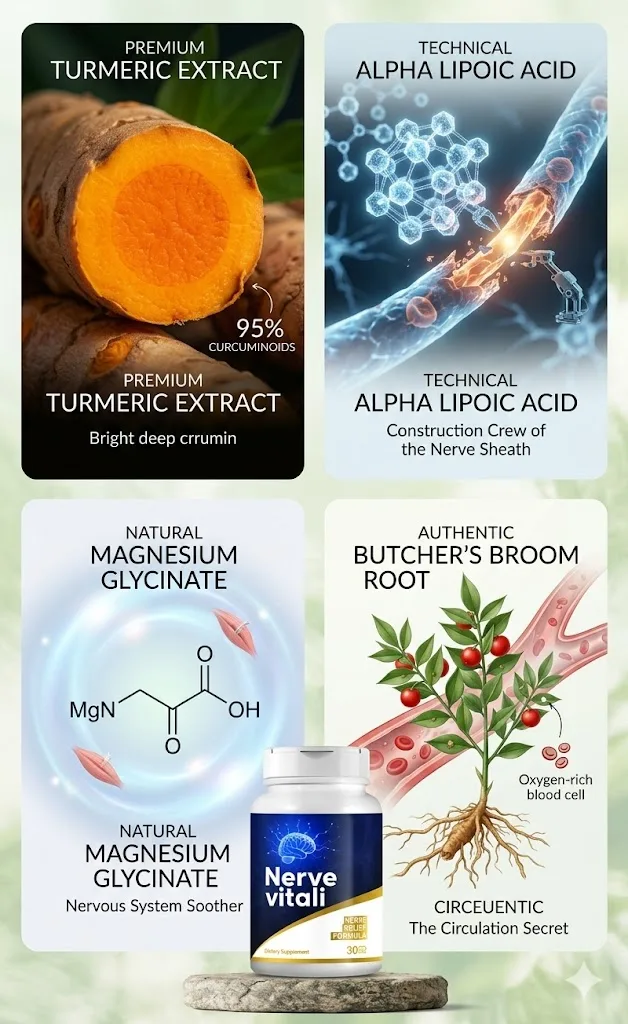
🔥 Turmeric Extract — 95% Curcuminoid Concentration
Assignment: Reduce Chronic Nerve Inflammation
Peripheral neuropathy creates a vicious cycle — damaged nerves trigger inflammation, and that inflammation damages nerves further. Curcumin breaks this loop. At 95% concentration, our extract delivers roughly 30 times the active compound found in kitchen turmeric. The anti-inflammatory mechanism targets COX-2 and NF-kB pathways specifically — the same pathways pharmaceutical anti-inflammatories target, but through a different biochemical route. Over 5,000 peer-reviewed papers have examined curcumin's effects, making it one of the most studied natural compounds in existence.
Referenced: National Center for Complementary and Integrative Health (NCCIH)
⚡ Alpha Lipoic Acid — Dual-Solubility Nerve Protector
Assignment: Shield the Myelin Sheath From Oxidative Damage
Most antioxidants work in one environment — water OR fat. Alpha lipoic acid works in both simultaneously. For nerves, this dual access means it can protect the fatty myelin sheath exterior AND the watery cell interior at the same time. No other single antioxidant can do this. German clinical practice — including for diabetic neuropathy — includes ALA in standard neuropathy protocols, and published data consistently shows improvements in nerve pain scores, burning feet symptoms, and nerve conduction speed. When numbness, tingling hands, and numb feet stem from oxidative damage to the myelin sheath, ALA is the compound with the deepest evidence base.
Referenced: Linus Pauling Institute, Oregon State University
🧬 Magnesium Glycinate — 80mg Bioavailable Dose
Assignment: Regulate Nerve Signal Excitability
Healthy nerves fire signals in controlled patterns. Damaged nerves fire chaotically — sending pain, tingling, and cramping signals even when nothing is actually wrong. Magnesium acts as the gatekeeper, controlling which signals pass and which get dampened. Deficiency — which NIH data shows affects nearly half of American adults — leaves nerves in a state of chronic overexcitement. That's the nighttime cramps, the restless legs, the persistent tingling. We specifically chose the glycinate form because it absorbs at dramatically higher rates than the magnesium oxide that fills most pharmacy shelves, and it doesn't cause the digestive problems that cheaper forms create.
Referenced: NIH Office of Dietary Supplements
🔋 L-Carnitine — Mitochondrial Energy Transporter
Assignment: Power Nerve Cell Repair From the Inside
A nerve cell trying to repair itself without adequate energy is like a construction crew without electricity — the materials might be there, but nothing gets built. L-Carnitine functions as the fuel delivery system, physically transporting fatty acid molecules into the mitochondria of nerve cells where they're converted to ATP energy. With sufficient cellular power, damaged nerves can rebuild connections, restore signal pathways, and gradually return sensation to numb extremities. Clinical research on acetyl-L-Carnitine has explored its specific role in peripheral neuropathy recovery and nerve regeneration.
Referenced: NIH Office of Dietary Supplements
🩸 Butcher's Broom Root Extract — Vascular Opening Agent
Assignment: Restore Blood Flow to Starving Nerve Endings
The nerve endings farthest from your heart — in your toes, fingers, and feet — are first to suffer when circulation declines. Butcher's Broom works by strengthening blood vessel walls and promoting vasodilation in the peripheral arteries that feed these distant nerve endings. When blood flow increases, so does the delivery of oxygen and nutrients that nerve tissue needs to survive, reverse nerve damage, and repair. Mediterranean healers used this shrub for circulatory complaints centuries before modern science confirmed the mechanism. The European Medicines Agency formally documents its traditional use for venous and circulatory support.
Referenced: European Medicines Agency (EMA)
🛡️ Coenzyme Q10 — Anti-Aging Nerve Shield
Assignment: Protect New Nerve Growth From Free Radical Destruction
Here's the frustrating reality of nerve repair without antioxidant protection: your body rebuilds a nerve fiber, and before it fully matures, free radicals swoop in and damage it all over again. CoQ10 prevents this cycle by positioning itself as a molecular bodyguard around newly formed nerve tissue. Simultaneously, it supports the mitochondrial energy production that nerve cells depend on for both function and repair. The complication: your body's natural CoQ10 output drops approximately 40% between age 20 and 60. Supplementation becomes increasingly important precisely when neuropathy risk peaks.
Referenced: NCCIH — Coenzyme Q10 Research